

- University
- Academic
- Schools/Vocational Schools
- Vocational School of Justice
- Vocational School
- Vocational School
- Department of Banking and Insurance (Turkish)
- Department of Computer Programming (Turkish)
- Department of Foreign Trade (Turkish)
- Department of Graphic Design (Turkish)
- Department of Interior Design (Turkish)
- Department of Construction Technology (Turkish)
- Department of Occupational Health and Safety (Turkish)
- Department of Media and Communication (Turkish)
- Department of Architectural Restoration (Turkish)
- Department of Radio and Tv Programming (Turkish)
- Department of Civil Aviation Cabin Services (Turkish)
- Department of Civil Aviation Transportation Management (Turkish)
- Department of Tourism and Hotel Management (Turkish)
- Department of Applied English Translation
- Vocational School Of Health Services
- Vocational School Of Health Services
- Department of Child Development (Turkish)
- Department of Physiotherapy (Turkish)
- Department of Paramedic (Turkish)
- Department of Opticianry (Turkish)
- Department of Medical Documentation and Secreteriat (Turkish)
- Department of Medical Imaging Techniques (Turkish)
- Department of Medical Laboratory Techniques (Turkish)
- Department of Elderly Care (Turkish)
- School of Applied Management Sciences
- School of Foreign Languages
- Faculties
- Faculty of Arts and Sciences
- Faculty of Fine Arts and Design
- Faculty of Law
- Faculty of Communication
- Faculty of Business
- Faculty of Engineering
- Faculty of Engineering
- Department of Computer Engineering
- Department of Biomedical Engineering
- Department of Electrical and Electronics Engineering
- Department of Industrial Engineering
- Department of Food Engineering
- Department of Genetics and Bioengineering
- Department of Aerospace Engineering
- Department of Civil Engineering
- Department of Mechanical Engineering
- Department of Mechatronics Engineering
- Department of Software Engineering
- Faculty of Health Sciences
- Medicine
- Graduate School
- Common Courses
- Schools/Vocational Schools
- Research
- Research Centers
- Library
- Smart Campus
- Technology Transfer Office
- İzmir Sciencepark
- Continuous Education Center (EKOSEM)
- Children's University
- Ethics Committee
- Teaching and Learning Center (EKOEĞİTİM)
- Psychology Application and Research Center
- Researcher Training Coordinatorship
- Research Collaborations And Innovation Coordinatorship
- Campus
- INTERNATIONAL
- Contact
- 25TH YEAR
Department of Computer Programming (Turkish)
Courses
Learning of description of basic number concepts, instantiation of numbers, sets, inequalities, problems, equations, functions ve trigonometry
Students will be taught how to use the written and verbal communication tools accurately and efficiently in this course. Various types of verbal and written statements will be examined through a critical point of view by doing exercises on understanding, telling, reading, and writing. Punctuation and spelling rules, which are basis of written statement, will be taught and accurate usage of these rules for efficient and strong expression will be provided. As for verbal statement, students will be taught how to use the body language, use accent and intonation elaborately, and use presentation techniques.
This is a compulsory English course which provides basic language skills such as reading, writing, listening and speaking at the beginning level.
The course will help students recognize the skills necessary for university life and personal development. These skills include self-awareness, goal setting, time management, effective communication, mindfulness, and analytical thinking. The course will also raise students' awareness of the habits essential for physical, mental, and spiritual health, as well as issues such as addiction and bullying.
This course covers fundamental programming concepts, algorithm development, and the processes of developing console-based and visual-based applications. Within the scope of the course, form design and user interface development applications are carried out.
This course provides a general information of the events from the end of the 19. century until the end of the Turkish War of Independence and the signing of the Treaty of Lausanne in 1923 and the following period until 1990’s.
This is a compulsory English course which provides basic language skills such as reading, writing, listening and speaking at the beginning level.
This course is a practical introduction to object-oriented programming, built upon the fundamental structures of the Python programming language. It begins with data structures, control flow and functions, and progresses systematically to class design, methods, and the basic concepts of encapsulation and inheritance. The course concludes with a project and an oral presentation at the end of the term, bringing together all the skills and knowledge acquired, and is rounded off with modules on file handling and exception handling.
System Analysis and Design Concept, Feasibility Analysis and Requirements Determination, Advanced System Analysis Concept, System Design, UML Diagrams, UML Object Based Modeling, Input Design, Output Design, Database Design, Software Development and Testing,
This course covers the fundamental structures of the Java programming language, object-oriented programming principles, class design, collection structures, and layered software development approaches. During the course, the fundamentals of REST API development and CRUD applications are examined through practical studies using the Spring Boot framework.
This course is a hands-on course that enables students to apply the theoretical knowledge and professional skills they have acquired during their education in a real-world work environment; it also allows them to gain firsthand experience with business processes, organizational culture, occupational health and safety practices, professional ethical principles, and the requirements of the workplace.
Elective Courses
MBIL 103 Database Systems
The core content of this course will cover database design, programming, and management phases in detail to provide students with comprehensive and detailed knowledge regarding the design and programming processes of database systems.
MBIL 106 Algorithmic Problem Solving and Analysis
This course includes algorithmic thinking, problem-solving approaches, and basic algorithm analysis concepts through practical applications. Throughout the course, algorithm development, pseudocode, decision-making mechanisms, and performance evaluation methods are examined.
MBIL 107 Artificial Intelligence and Blockchain
This course includes the basic concepts and methods of Blockchain and artificial intelligence, machine learning, deep learning, Python programming language, artificial neural networks.
MBIL 109 Application Development on Low Code Platforms
This course covers low code platform structures and usage of these platforms.
MBIL 110 Server Operating System
This course covers topics such as the general features of operating systems, the differences between server and client, process and network management, operating system installation and configuration, server management, server kernel, web server, print server, terminal server, file system and services, server deployment services, other services, network sharing, DNS and DHCP services, network load balancing, performance and security measures, network policies, virtualization, and update issues..
MBIL 112 Basics of Networking
This course includes the concepts of computer networks, networks addresses, and network cables. Networks security will also be discussed in this course.
MBIL 114 Office Software
MBIL 116 Web Design
MBIL 118 Software Installation and Management
The content of this course consists of main topics that are the installation of operating system and hardware drivers, adjusting and management of system properties,resources.
MBIL 120 Game Design and Programming
MBIL 122 Project Management in Information Technologies
MBIL 124 Test and Control in Software Development
MBIL 126 Open Source Operating System
MBIL 128 Work Safety and First Aid
MBIL 130 Entrepreneurship and Innovation
MBIL 132 Strategic Management
MBIL 134 Project Development
MBIL 136 Internet Programming I
Basic content, HTTP rules and methods, HTML / CSS web design formats, client side JavaScript entry, and server side PHP usage
MBIL 138 Human-Computer Interaction
MBIL 201 User Experience and Interface Design
This course covers the concepts of user experience and user interface, human-computer interaction, user-centered design approaches, and web, mobile, and desktop interface design approaches. During the course, fundamental design tools and user experience applications are examined.
MBIL 207 Database and Management
MBIL 209 Visual Programming III
MBIL 211 Introduction to Game Programming
MBIL 213 Electronic Commerce Systems and Applications
MBIL 215 Mobile Applications and Technologies
MBIL 217 Data Science and Machine Learning
MBIL 219 Visual Programming II
MBIL 221 Internet Programming II
This course introduces the students to the fundamental concepts of programming using the PHP programming language.
MBIL 223 Network and Cyber Security
This course covers the fundamental concepts of cyber security, network and system security, malware, attack types, security vulnerabilities, data protection methods, and secure software development.
MBIL 225 Artificial Intelligence Assisted Software Development
This course provides a hands-on exploration of the integration of Artificial Intellegence tools into software development processes, prompt engineering techniques, and application development using Large Language Model APIs. Students will reinforce their theoretical knowledge through weekly lab sessions and a final project; they will develop an Artificial Intelligence-powered software application and present it to the class.
MTUR 225 Entrepreneurship
Providing theoretical information on entepreneurship and formulating a business plan, analyzing successful business models, preparing and presenting business models.
NEWSALL NEWS


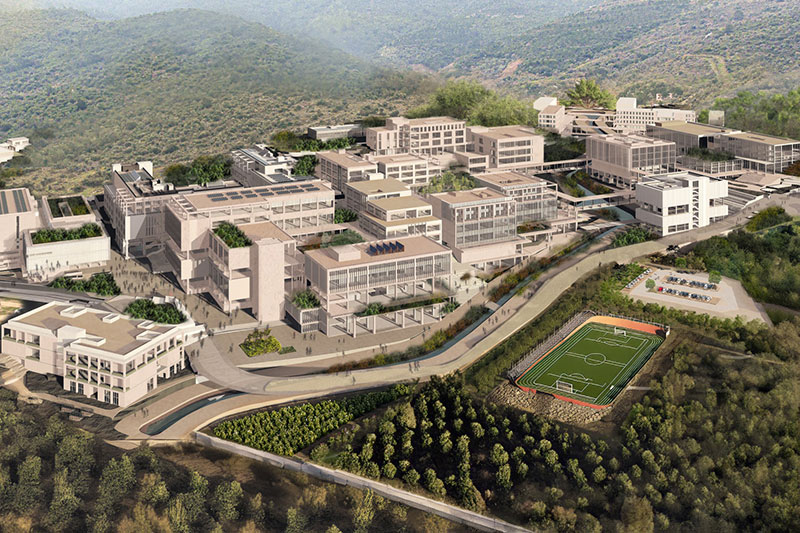
IZMIR UNIVERSITY OF ECONOMICS GÜZELBAHÇE CAMPUS
DetailsGLOBAL CAREER
As Izmir University of Economics transforms into a world-class university, it also raises successful young people with global competence.
More..CONTRIBUTION TO SCIENCE
Izmir University of Economics produces qualified knowledge and competent technologies.
More..VALUING PEOPLE
Izmir University of Economics sees producing social benefit as its reason for existence.
More..
You are one step ahead with your graduate education at Izmir University of Economics.