

- University
- Academic
- Schools/Vocational Schools
- Vocational School of Justice
- Vocational School
- Vocational School
- Department of Banking and Insurance (Turkish)
- Department of Computer Programming (Turkish)
- Department of Foreign Trade (Turkish)
- Department of Graphic Design (Turkish)
- Department of Interior Design (Turkish)
- Department of Construction Technology (Turkish)
- Department of Occupational Health and Safety (Turkish)
- Department of Media and Communication (Turkish)
- Department of Architectural Restoration (Turkish)
- Department of Radio and Tv Programming (Turkish)
- Department of Civil Aviation Cabin Services (Turkish)
- Department of Civil Aviation Transportation Management (Turkish)
- Department of Tourism and Hotel Management (Turkish)
- Department of Applied English Translation
- Vocational School Of Health Services
- Vocational School Of Health Services
- Department of Child Development (Turkish)
- Department of Physiotherapy (Turkish)
- Department of Paramedic (Turkish)
- Department of Opticianry (Turkish)
- Department of Medical Documentation and Secreteriat (Turkish)
- Department of Medical Imaging Techniques (Turkish)
- Department of Medical Laboratory Techniques (Turkish)
- Department of Elderly Care (Turkish)
- School of Applied Management Sciences
- School of Foreign Languages
- Faculties
- Faculty of Arts and Sciences
- Faculty of Fine Arts and Design
- Faculty of Law
- Faculty of Communication
- Faculty of Business
- Faculty of Engineering
- Faculty of Engineering
- Department of Computer Engineering
- Department of Biomedical Engineering
- Department of Electrical and Electronics Engineering
- Department of Industrial Engineering
- Department of Food Engineering
- Department of Genetics and Bioengineering
- Department of Aerospace Engineering
- Department of Civil Engineering
- Department of Mechanical Engineering
- Department of Mechatronics Engineering
- Department of Software Engineering
- Faculty of Health Sciences
- Medicine
- Graduate School
- Common Courses
- Schools/Vocational Schools
- Research
- Research Centers
- Library
- Smart Campus
- Technology Transfer Office
- İzmir Sciencepark
- Continuous Education Center (EKOSEM)
- Children's University
- Ethics Committee
- Teaching and Learning Center (EKOEĞİTİM)
- Psychology Application and Research Center
- Researcher Training Coordinatorship
- Research Collaborations And Innovation Coordinatorship
- Campus
- INTERNATIONAL
- Contact
- 25TH YEAR
Department of Tourism and Hotel Management (Turkish)
RTV 150 | Course Introduction and Application Information
| Course Name |
Effective Communication Skills
|
|
Code
|
Semester
|
Theory
(hour/week) |
Application/Lab
(hour/week) |
Local Credits
|
ECTS
|
|
RTV 150
|
Fall
|
1
|
2
|
2
|
3
|
| Prerequisites |
None
|
|||||
| Course Language |
Turkish
|
|||||
| Course Type |
Required
|
|||||
| Course Level |
Short Cycle
|
|||||
| Mode of Delivery | - | |||||
| Teaching Methods and Techniques of the Course | DiscussionGroup WorkCase StudyQ&AGuest SpeakerLecture / Presentation | |||||
| National Occupation Classification | - | |||||
| Course Coordinator | - | |||||
| Course Lecturer(s) | ||||||
| Assistant(s) | - | |||||
| Course Objectives | The aim of this course is to enable students to understand the fundamental principles of effective communication, to communicate in a healthy and productive manner with different individuals and groups in various contexts, to express themselves clearly and coherently, and to adopt a solution-oriented approach to problems that may arise during the communication process. The course aims to develop students’ active listening, empathy, feedback-giving, persuasive speaking, conflict management, and professional communication skills in both face-to-face and digital environments. |
| Learning Outcomes |
The students who succeeded in this course;
|
| Course Description | The Effective Communication Skills course is a practice-based course designed to enable students to communicate consciously, clearly, effectively, and responsibly in their personal, academic, social, and professional lives. Within the scope of the course, key topics such as the communication process, verbal and non-verbal communication, listening skills, empathy, self-presentation, body language, persuasion, conflict management, public speaking, and digital communication are addressed with a sector-based approach. In line with communication theories and contemporary examples, students have the opportunity to evaluate their own communication styles, develop strategies appropriate to different communication contexts, and strengthen their effective expression skills. |
| Related Sustainable Development Goals |
|
|
|
Core Courses | |
| Major Area Courses | ||
| Supportive Courses | ||
| Media and Management Skills Courses | ||
| Transferable Skill Courses |
WEEKLY SUBJECTS AND RELATED PREPARATION STUDIES
| Week | Subjects | Related Preparation |
| 1 | Introduction to communication: Approaches within psychology, sociology, and anthropology | Akman, M. K. & Özer, H. (2016). İletişim sarmalları: Sosyo-psikolojik boyutlarıyla iletişimi yeniden düşünmek. Ordu Üniversitesi Sosyal Bilimler Enstitüsü Sosyal Bilimler Araştırmaları Dergisi, 6(15), 307-316.; Aziz, A. (2013). İletişime giriş (s. 25-36). Hiperlink. |
| 2 | The communication process and its elements: Human–human, human–corporation, and human–technology communication | İplikçi, H. G. (2015). İletişimde temel modeller ve kitle iletişim modelleri. Sosyal ve Beşeri Bilimleri Dergisi, 7(2); Güngör, N. (2015). İletişime giriş (s. 19-33). Siyasal Kitapevi. |
| 3 | Linear, circular, and spiral models of communication | Yüksel, E. (2013). İletişim kuramlarına giriş. E. Yüksel (Ed.), İletişim Kuramları (ss.2-34), Eskişehir: Anadolu Üniversitesi Yayınları. |
| 4 | Written communication and artificial intelligence | Mısırlı, İ. (2021). Genel ve teknik iletişim: Kavramlar, ilkeler ve uygulamalar (s. 38-77, 102-125). Detay Yayıncılık. |
| 5 | Oral communication skills: Rhetoric, persuasion, and debate | Doğanay, Ü., & Keskin, F. (2008). İletişim çalışmalarında kişilerarası iletişimin yeri: Türkiye'deki kişilerarası iletişim eğitimi üzerine bir değerlendirme. Kültür ve İletişim, 11(1), 9-32. |
| 6 | Non-verbal communication and body language | Gürüz, D. & Eğinli, A. T. (2018). İletişim becerileri: Anlamak, anlatmak, anlaşmak (6. Baskı, s. 251-280). Nobel Akademik Yayıncılık. Kocasavaş, Y. (2007). Etkili iletişimin sözsüz adımı olan beden dili ve Türkçe eğitimdeki rolü. Hasan Ali Yücel Eğitim Fakültesi Dergisi, 7(1), 47-55. |
| 7 | Effective presentation techniques | Cialdini, R. (2003). İknanın psikolojisi: Teorik ve pratik bir arada. Çev: Yasemin Fletcher. İstanbul: Mediacat Yayıncılık. Siddons, S. (2008). The complete presentation skills handbook: How to understand and reach your audience for maximum impact and success. London: Kogan Page Publishers. Sarıdoğan, E. (2013). Toplantı ve sunum teknikleri (sf. 5-23). Papatya Bilim. ISBN 6054220564. |
| 8 | General evaluation | |
| 9 | Personal branding / Student presentations | Güngör, N. (2015). İletişime Giriş, Siyasal Kitabevi, 3. Baskı. ISBN: 978-605-5782-59-7 Sayfa: 139-180. Aziz, A. (2013). İletişime Giriş, Hiperlink, 4. Baskı. ISBN: 978-9944-157-14-8 Sayfa: 57-59. |
| 10 | Digital communication, image, and reputation management / Student presentations | Karahisar, T. (2013). Dijital nesil, dijital iletişim ve dijitalleşen. AJIT‐e: Online Academic Journal of Information Technology, 4(12), 72-81. Walther, J. B. (1996). Computer-mediated communication: Impersonal, interpersonal, and hyperpersonal interaction. Communication Research, 23(1), 3–43. https://doi.org/10.1177/009365096023001001 Fombrun, C., & Shanley, M. (1990). What’s in a name? Reputation building and corporate strategy. Academy of Management Journal, 33(2), 233–258. https://doi.org/10.5465/256324 |
| 11 | Corporate communication / Student presentations | Durğun, S. (2006). Örgüt kültürü ve örgütsel iletişim. Yüzüncü Yıl Üniversitesi Eğitim Fakültesi Dergisi. 1(2), 112-132. van Riel, C. B. M. (1997). Research in corporate communication: An overview of an emerging field. Management Communication Quarterly, 11(2), 288–309. https://doi.org/10.1177/0893318997112005 Cornelissen, J., van Bekkum, T., & van Ruler, B. (2006). Corporate communications: A practice-based theoretical conceptualization. Corporate Reputation Review, 9(2), 114–133. https://doi.org/10.1057/palgrave.crr.1550015 |
| 12 | Emotional labor / Student presentations | Ashforth, B. E., & Humphrey, R. H. (1993). Emotional labor in service roles: The influence of identity. Academy of Management Review, 18(1), 88–115. https://doi.org/10.5465/AMR.1993.3997508 Grandey, A. A. (2000). Emotion regulation in the workplace: A new way to conceptualize emotional labor. Journal of Occupational Health Psychology, 5(1), 95–110. https://doi.org/10.1037/1076-8998.5.1.95 |
| 13 | Intercultural communication / Student presentations | Güngör, N. (2015). İletişime Giriş, Siyasal Kitabevi, 3. Baskı. ISBN: 978-605-5782-59-7 Sayfa: 180-197 / 210- 251. Aziz, A. (2013). İletişime Giriş, Hiperlink, 4. Baskı. ISBN: 978-9944-157-14-8 Sayfa: 59/ 113- 135. |
| 14 | Case studies (sector-based current events) | |
| 15 | Case studies (sector-based current events) | |
| 16 | General evaluation |
| Course Notes/Textbooks |
|
| Suggested Readings/Materials | Books:
Video contents:
Blogs:
Podcast:
Websites:
Movies:
Documentaries:
Journals:
|
EVALUATION SYSTEM
| Semester Activities | Number | Weigthing |
| Participation |
1
|
10
|
| Laboratory / Application | ||
| Field Work | ||
| Quizzes / Studio Critiques |
2
|
30
|
| Portfolio | ||
| Homework / Assignments |
1
|
10
|
| Presentation / Jury |
1
|
20
|
| Project |
1
|
30
|
| Seminar / Workshop | ||
| Oral Exams | ||
| Midterm | ||
| Final Exam |
1
|
|
| Total |
| Weighting of Semester Activities on the Final Grade |
6
|
100
|
| Weighting of End-of-Semester Activities on the Final Grade | ||
| Total |
ECTS / WORKLOAD TABLE
| Semester Activities | Number | Duration (Hours) | Workload |
|---|---|---|---|
| Theoretical Course Hours (Including exam week: 16 x total hours) |
16
|
1
|
16
|
| Laboratory / Application Hours |
16
|
2
|
32
|
| Study Hours Out of Class |
0
|
||
| Field Work |
0
|
||
| Quizzes / Studio Critiques |
2
|
10
|
20
|
| Portfolio |
0
|
||
| Homework / Assignments |
1
|
4
|
4
|
| Presentation / Jury |
1
|
8
|
8
|
| Project |
1
|
10
|
10
|
| Seminar / Workshop |
0
|
||
| Oral Exam |
0
|
||
| Midterms |
0
|
||
| Final Exam |
1
|
0
|
|
| Total |
90
|
COURSE LEARNING OUTCOMES AND PROGRAM QUALIFICATIONS RELATIONSHIP
|
#
|
Program Competencies/Outcomes |
* Contribution Level
|
|||||
|
1
|
2
|
3
|
4
|
5
|
|||
| 1 |
Has a basic knowledge of major theories, phenomena, concepts, and principles in the field of tourism. |
-
|
-
|
-
|
-
|
-
|
|
| 2 |
Associate the professional knowledge acquired in the field with other disciplines and use it in the field of application. |
-
|
-
|
-
|
-
|
-
|
|
| 3 |
Uses modern techniques and tools required to perform tourism services. |
-
|
-
|
-
|
-
|
-
|
|
| 4 |
Uses computer software, automation systems and information technologies as required by the field of tourism and hotel management. |
-
|
-
|
-
|
-
|
-
|
|
| 5 |
Improves himself / herself by following the developments in his / her field with the awareness of lifelong learning. |
-
|
-
|
-
|
-
|
-
|
|
| 6 |
Has basic knowledge of legal regulations, professional standards, ethical principles, and professional awareness in the field. |
-
|
-
|
-
|
-
|
-
|
|
| 7 |
Communicates effectively with guests and collaborators in written and verbal expressions. |
-
|
-
|
-
|
-
|
-
|
|
| 8 |
Develops creative and innovative solutions individually and as a team to possible problems that may be encountered in tourism services. |
-
|
-
|
-
|
-
|
-
|
|
| 9 |
Has knowledge on occupational safety, worker health, environmental protection and has quality awareness. |
-
|
-
|
-
|
-
|
-
|
|
| 10 |
Demonstrates reading, understanding, speaking, and writing skills in English at least at the A2 level of the European Language Portfolio. |
-
|
-
|
-
|
-
|
-
|
|
| 11 |
Follows the information about tourism and hotel management and communicates with colleagues using two foreign languages. |
-
|
-
|
-
|
-
|
-
|
|
*1 Lowest, 2 Low, 3 Average, 4 High, 5 Highest
NEWSALL NEWS


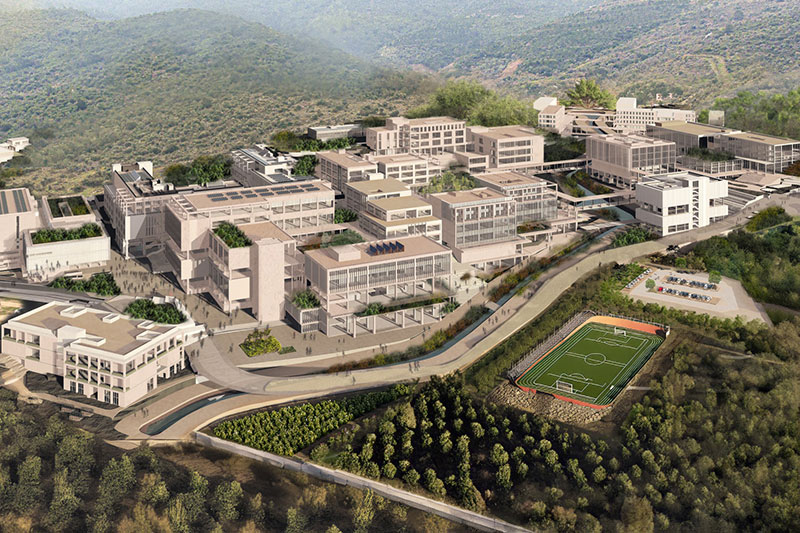
IZMIR UNIVERSITY OF ECONOMICS GÜZELBAHÇE CAMPUS
DetailsGLOBAL CAREER
As Izmir University of Economics transforms into a world-class university, it also raises successful young people with global competence.
More..CONTRIBUTION TO SCIENCE
Izmir University of Economics produces qualified knowledge and competent technologies.
More..VALUING PEOPLE
Izmir University of Economics sees producing social benefit as its reason for existence.
More..
You are one step ahead with your graduate education at Izmir University of Economics.