

- University
- Academic
- Schools/Vocational Schools
- Vocational School of Justice
- Vocational School
- Vocational School
- Department of Banking and Insurance (Turkish)
- Department of Computer Programming (Turkish)
- Department of Foreign Trade (Turkish)
- Department of Graphic Design (Turkish)
- Department of Interior Design (Turkish)
- Department of Construction Technology (Turkish)
- Department of Occupational Health and Safety (Turkish)
- Department of Media and Communication (Turkish)
- Department of Architectural Restoration (Turkish)
- Department of Radio and Tv Programming (Turkish)
- Department of Civil Aviation Cabin Services (Turkish)
- Department of Civil Aviation Transportation Management (Turkish)
- Department of Tourism and Hotel Management (Turkish)
- Department of Applied English Translation
- Vocational School Of Health Services
- Vocational School Of Health Services
- Department of Child Development (Turkish)
- Department of Physiotherapy (Turkish)
- Department of Paramedic (Turkish)
- Department of Opticianry (Turkish)
- Department of Medical Documentation and Secreteriat (Turkish)
- Department of Medical Imaging Techniques (Turkish)
- Department of Medical Laboratory Techniques (Turkish)
- Department of Elderly Care (Turkish)
- School of Applied Management Sciences
- School of Foreign Languages
- Faculties
- Faculty of Arts and Sciences
- Faculty of Fine Arts and Design
- Faculty of Law
- Faculty of Communication
- Faculty of Business
- Faculty of Engineering
- Faculty of Engineering
- Department of Computer Engineering
- Department of Biomedical Engineering
- Department of Electrical and Electronics Engineering
- Department of Industrial Engineering
- Department of Food Engineering
- Department of Genetics and Bioengineering
- Department of Aerospace Engineering
- Department of Civil Engineering
- Department of Mechanical Engineering
- Department of Mechatronics Engineering
- Department of Software Engineering
- Faculty of Health Sciences
- Medicine
- Graduate School
- Common Courses
- Schools/Vocational Schools
- Research
- Research Centers
- Library
- Smart Campus
- Technology Transfer Office
- İzmir Sciencepark
- Continuous Education Center (EKOSEM)
- Children's University
- Ethics Committee
- Teaching and Learning Center (EKOEĞİTİM)
- Psychology Application and Research Center
- Researcher Training Coordinatorship
- Research Collaborations And Innovation Coordinatorship
- Campus
- INTERNATIONAL
- Contact
- 25TH YEAR
Department of Interior Design (Turkish)
Courses
Learning of description of basic number concepts, instantiation of numbers, sets, inequalities, problems, equations, functions ve trigonometry
Aim of this course is to make scaled drawings with right drawing techniques and correct use of drawing materials.
The course will help students recognize the skills necessary for university life and personal development. These skills include self-awareness, goal setting, time management, effective communication, mindfulness, and analytical thinking. The course will also raise students' awareness of the habits essential for physical, mental, and spiritual health, as well as issues such as addiction and bullying.
This is a compulsory English course which provides basic language skills such as reading, writing, listening and speaking at the beginning level.
Students will be taught how to use the written and verbal communication tools accurately and efficiently in this course. Various types of verbal and written statements will be examined through a critical point of view by doing exercises on understanding, telling, reading, and writing. Punctuation and spelling rules, which are basis of written statement, will be taught and accurate usage of these rules for efficient and strong expression will be provided. As for verbal statement, students will be taught how to use the body language, use accent and intonation elaborately, and use presentation techniques.
Course contains basic design principles. Visual art elements such aslight-shadow, print, texture are generally used.
In terms of this course students will learn materials used on constructions, production methods of materials and application types, choosing appropriate materials on department of constructions.
This course provides a general information of the events from the end of the 19. century until the end of the Turkish War of Independence and the signing of the Treaty of Lausanne in 1923 and the following period until 1990’s.
This is a compulsory English course which provides basic language skills such as reading, writing, listening and speaking at the beginning level.
This course covers the basic concepts and historical development of occupational health and safety, as well as the concepts of hazard and risk. It includes fire types and preventive measures, physical, chemical, biological, and psychosocial risk factors, and relevant legislation in the field of occupational health and safety.
In this course basic elements and systems of interior design will be introduced, importance of the interior design will be explained, human ergonomics and universal design criteria will be taught.
This course contains topics such as smart houses, coatings, plaster, doors and windows, work safety and earthquake regulations, insulation, plastering works.
Working on drawing and presentation techniques using AutoCad and Photoshop programs
In this course, students will apply their knowledge on interior design projects.
The main contents of this course are; surface creation, surface model solid model conversion, block using space creation, creating cross-section drawings.
This course is a hands-on course that enables students to apply the theoretical knowledge and professional skills they have acquired during their education in a real-world work environment; it also allows them to gain firsthand experience with business processes, organizational culture, occupational health and safety practices, professional ethical principles, and the requirements of the workplace.
Elective Courses
MICT 102 Cost Accounting
MICT 105 Interior Furnishings
This course covers wall construction, door fabrication and installation, window fabrication and installation, shutter fabrication and installation, stairs and partition panels, floor finishes, wall finishes, types and applications of wood and wood-based wall paneling, and the fabrication and installation of ceiling finishes.
MICT 107 Basic Processes in Furniture Production
In this lesson, cutting the pieces of furniture in the furniture production, planing, drilling, surface / edge, basic operations such as shaping and surface coating.
MICT 110 Furniture Design and Construction
MICT 205 Model Making for Interior Spaces
Making interior design models with using appropriate model making materials.
MICT 207 Current Approaches in Furniture Design
Furniture design criteria, materials used in furniture making and accessories will be introduced and their properties will be explained. The design process of a furniture is discussed and it includes subjects such as the technical drawings of the furniture design according to the identified problems and related prototypes and then the applications in the work shop environment.
MICT 209 Ergonomics
This course includes the definition of ergonomics, importance, ergonomic elements in furniture design and production, ergonomic rules in creating interior space, relation between efficiency and ergonomics, accidents, ergonomic elements in the prevention of accidents.
MICT 211 Quality Assurance and Standards
This course includes building the infrastructure of the quality management system, applying quality standards, and applying statistical quality control methods.
MICT 213 Recycling Design
Making new designs with recyclable materials.
MICT 215 Sustainable Ecological Design Studio
Discuss the concepts of sustainability and ecology with sectoral groups
MICT 217 Integrated Management Systems and Applications in the Furniture Industry
MICT 219 Lighting Techniques
This course includes the aim and types of illumination, photometric magnitudes, photometric laws, components of lighting, light and vision, light sources, lighting calculation.
MICT 221 Special Solutions for the Disabled
The main topics of this course are to understand the situation of the disabled in Turkey , to develop the functional design ideas for the disabled and order to meet their needs in daily life.
MICT 223 Production Management
This course includes topics such as factory site selection, production methods, plant repair and maintenance planning, product design, factory layout, machine and system capacity calculation, workflow diagrams for preparing minimum cost maximum production plans
NEWSALL NEWS

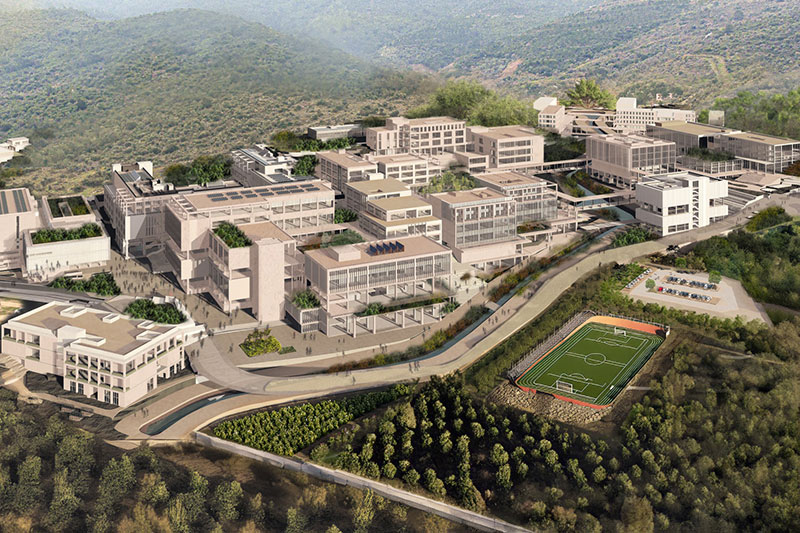
IZMIR UNIVERSITY OF ECONOMICS GÜZELBAHÇE CAMPUS
DetailsGLOBAL CAREER
As Izmir University of Economics transforms into a world-class university, it also raises successful young people with global competence.
More..CONTRIBUTION TO SCIENCE
Izmir University of Economics produces qualified knowledge and competent technologies.
More..VALUING PEOPLE
Izmir University of Economics sees producing social benefit as its reason for existence.
More..
You are one step ahead with your graduate education at Izmir University of Economics.